🌹 The Real Sleeping Beauty: Sun, Moon, and Talia 🌹
By Diadharma – 19 Dec 2025
Welcome back to the circle, dear wanderers. Today, we step away from the shimmering towers of modern retellings and journey deep into the tangled thickets of the past. Most of us think we know the story of the princess in the enchanted sleep, but the original tale of Sun, Moon, and Talia is a history many are surprised to learn.
The Palace of Stillness
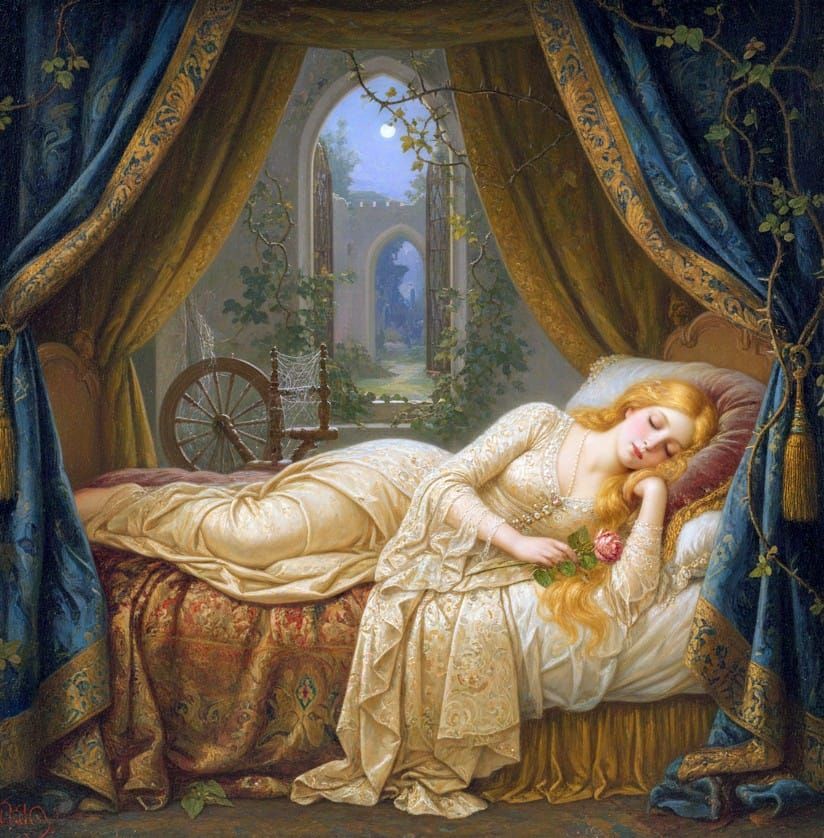
In the 17th-century Italian tale by Giambattista Basile, the maiden Talia falls into a deep, death-like trance after a splinter of flax becomes embedded under her fingernail. Her father, unable to bear the loss, leaves her resting upon a velvet throne in a palace hidden deep within the woods. There she remained, a figure of gold and silk, while the world moved on without her.
The Birth of the Sun and Moon
While Talia lay in her unnatural slumber, a wandering King discovered the hidden palace. This is where the story takes a dark turn that modern audiences would find distasteful. The King, finding her beautiful and impossible to wake, takes advantage of Talia in her slumber and then returns to his own kingdom. This part of the story has been heavily edited out of modern day versions and all but forgotten. From this encounter, Talia gave birth to two children, while still in her deep sleep. These children were named Sun and Moon. They were tended to by two fairies who appeared in the palace to care for them while their mother remained in her trance.
The Awakening
The spell of the flax was eventually broken not by a kiss, but by the children. As one of the infants searched for a nursing breast, it accidentally sucked the splinter of flax from Talia's finger. With the splinter removed, Talia finally opened her eyes and returned to the world of the living, awakening to find her celestial children, Sun and Moon, by her side.
The Collector of Tales: Giambattista Basile
This version of the story was first published in 1634 in a collection titled Lo cunto de li cunti (The Tale of Tales), or the Pentamerone. Its author, Giambattista Basile, was an Italian courtier and poet who spent his life collecting oral traditions from the Mediterranean and the mountains of Southern Italy. During the 17th century, these stories were not intended for children; they were Baroque entertainments for adults, filled with the raw, earthy, and often dark realities of the time. Basile wrote in a rich Neapolitan dialect, capturing the folk-spirit of Italy long before the Brothers Grimm or Charles Perrault smoothed the edges of these legends to fit a more delicate audience. His work remains one of the oldest and most important records of the stories that would eventually become our modern fairy tales.