⚓ The Mist-Veiled Mother: Nehalennia and the Spirit of the North Sea ⚓
By Diadharma – 25 Dec 2025
Welcome back to the circle. Today, my heart turns toward the salt-sprayed coasts of the North Sea—a landscape of shifting dunes, grey waves, and a history as deep as the Hanseatic tides. Part of my own heritage traces back to these windswept places, specifically the island of Sylt and the ancient trade routes of the Hanseatic League. In these territories, the spirit of the land is inextricably tied to the water, and it is here that we find the quiet, powerful presence of the goddess Nehalennia.
The Call of the Patron Goddess
On our spiritual paths, we often find ourselves drawn to the concept of a patron goddess. While many of us work with multiple deities throughout our lives, there is a unique potency in the archetypes tied to our heritage or the land of our birth. These "Land-Goddesses" carry the frequency of our ancestors' prayers and the specific magic of the soil—or in this case, the sand—that formed us. For those with Frisian blood or roots in the North Sea, Nehalennia emerges as a primary guardian of that lineage.
Reclaimed from the Depths
For centuries, Nehalennia was a forgotten name, resting beneath the waves and the silt. It wasn't until 1647, and later in the 1970s, that she returned to us. Fishermen and archaeologists discovered a wealth of altars and votive stones dedicated to her near the coast of the Netherlands.
These archaeological finds revealed a goddess who reigned over the precarious lives of sailors and merchants. The sailors of the Roman era and the early Germanic tribes would visit her shrines before crossing the treacherous North Sea to Britain. If they returned safely, they would fulfill a vow by dedicating an altar in her honor—a physical "thank you" for protection against the North Sea’s notorious storms.
Symbols of the Shore: The Dog and the Basket
When you look at the ancient carvings of Nehalennia, she is almost always depicted with two distinct and comforting symbols:
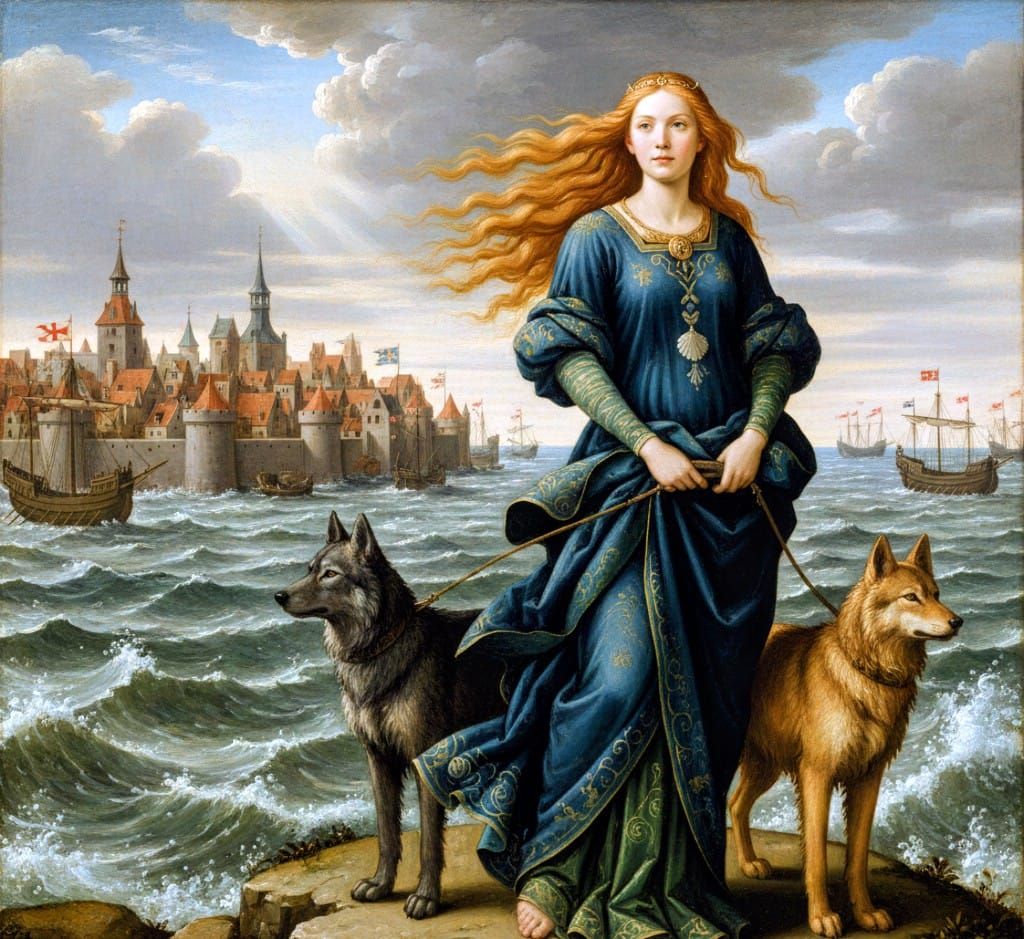
- The Basket of Fruit: Usually resting in her lap or by her side, this symbolizes the abundance and prosperity she granted to the merchants who traded along the coast.
- The Faithful Dog: At her feet, there is almost always a dog. In her context, the dog is not just a companion, but a guardian and a guide between worlds. It represents loyalty and protection, watching over the hearth while the sailors were at sea, and perhaps watching over the souls of those the sea claimed.
The Frisian Connection
Nehalennia’s influence is deeply woven into the Frisian culture and the surrounding Germanic territories. The Frisians were—and are—a people defined by their relationship with the water, building their lives on "terps" (raised mounds) to stay above the tides. In this culture, a deity like Nehalennia wasn't a distant figure in a high temple; she was a practical, essential presence. She was the one who ensured the ships of the Hanseatic spirit could navigate the fog and that the hearths of Sylt stayed warm.
Whether she is a patron of your bloodline or simply a goddess of the threshold you admire, Nehalennia reminds us that we are never truly alone when we face the vast, unknown oceans of our lives.